

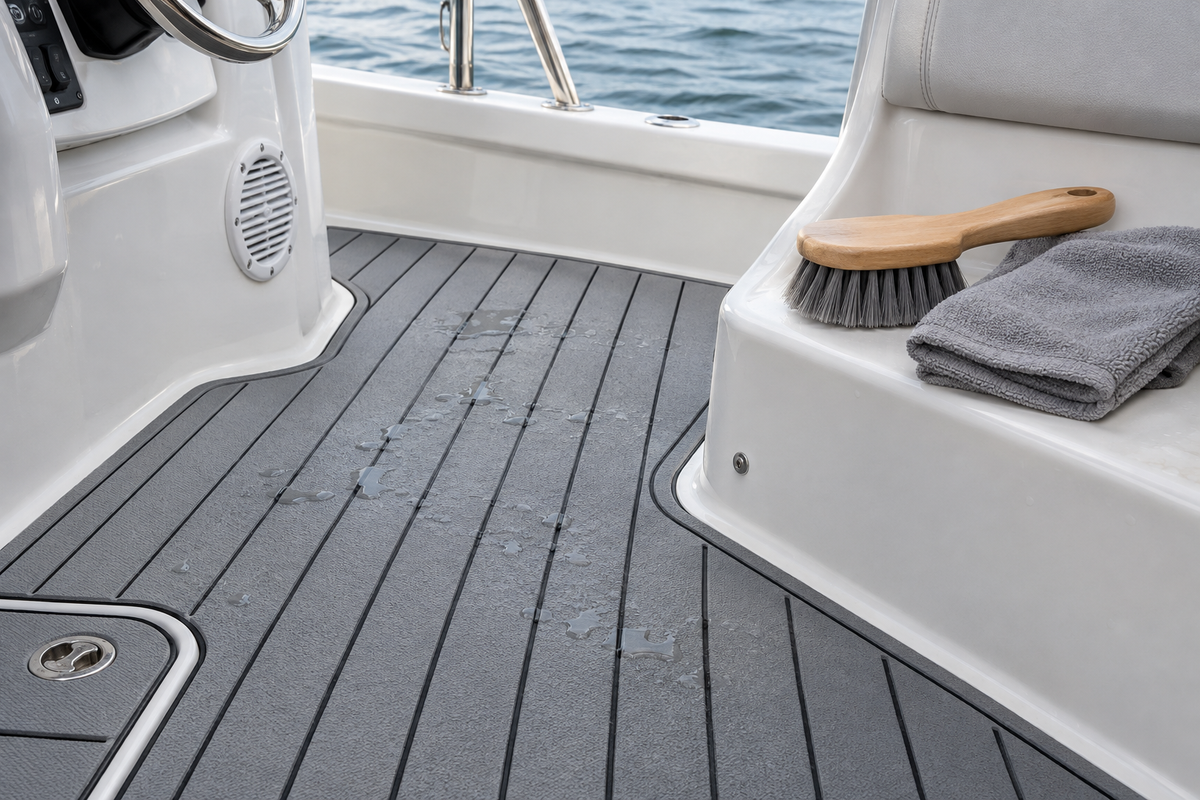
AI-generated editorial illustration of foam-deck care, not a product demonstration.
Foam decking is comfortable underfoot, but footprints, food and everyday grime still need to come off. The routine can stay simple: use a cleaner the decking maker allows, brush without tearing up the surface, and rinse thoroughly.
You don’t need to treat it like polished gelcoat. Here’s a practical way to keep it clean.
Start with the right cleaner and brush
Check the care instructions for your particular decking. Some foam manufacturers allow soap and water for routine cleaning; others recommend a dedicated cleaner. Brush recommendations vary too.
If the soap already in your wash kit is approved for the decking, you may not need another bottle. If it isn’t, use the recommended cleaner. A product being suitable for the hull doesn’t establish that it’s suitable for the foam or the adhesive underneath.
Keep the wash straightforward
- Clear away loose debris, then rinse with fresh water.
- Apply the approved cleaner according to its directions. Work on a cool surface, out of direct sun where practical, and tackle one manageable area at a time.
- Use the recommended brush to work dirt out of the texture. Along pad edges and seams, brush lengthwise rather than catching the edge and pushing it upward.
- Rinse away the cleaner and loosened dirt, then let the deck dry.
Use a regular hose for this routine. A pressure washer can cut or mark foam if the nozzle gets too close, so it’s not a useful shortcut for an ordinary wash.
Handle spills while they’re fresh
Pick up food and wipe up spills when it’s safe to do so. Prompt cleanup helps keep a small mess from becoming a stubborn stain.
For a remaining mark, use the decking manufacturer’s advice for that type of stain. Rust, sunscreen and general dirt may need different treatment. Don’t borrow an acid hull-cleaning method or reach for a solvent simply because it worked somewhere else on the boat.
Keep cleaners within their specified dilution and contact time. More concentrated product or a longer soak isn’t automatically a better approach.
Skip the polishing routine
Foam decking doesn’t need the compound-and-polish treatment used to restore gelcoat. Keep abrasive correction products off it, and don’t add wax or a gloss dressing unless the decking manufacturer specifically calls for that product.
The goal is a clean, comfortable walking surface. There’s no need to chase a glossy finish.
Make it part of your normal wash
Clean the foam as part of your after-use boat wash, while using the appropriate method for each neighboring surface. If a pad edge is lifting, avoid scrubbing underneath it and ask the installer about repair.
Keep the approved cleaner and brush with your everyday boat-cleaning kit. With the right tools ready, routine foam-deck care can remain a straightforward cleaning job.
Share:
Boat cleaning kit: what to keep aboard