

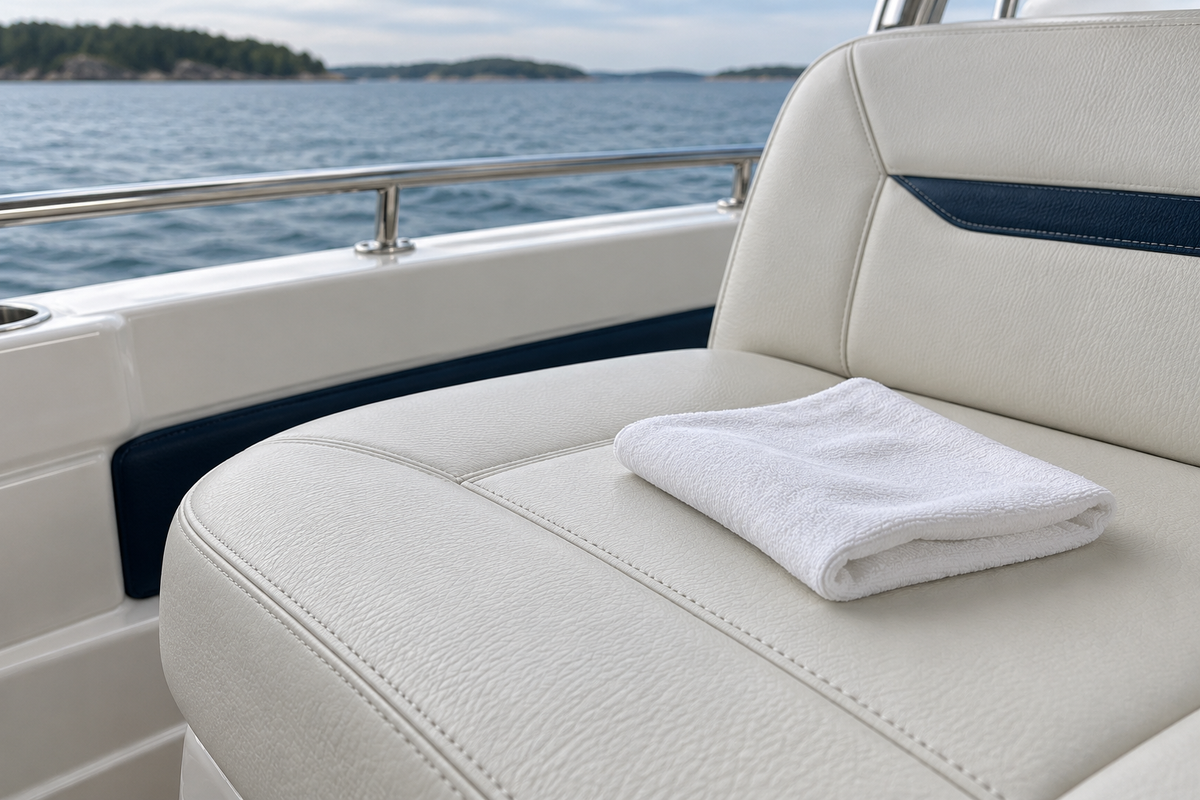
Illustrative image of routine boat-seat care.
Your boat seats should not need a shelf full of products for an ordinary cleanup. Start by identifying the upholstery, use its approved cleaning method, and stop when the job is done.
The important detail is easy to miss: “marine vinyl” does not give every seat the same care requirements. A cleaner or protectant that suits one upholstery material may not belong on another. The boat or upholstery manufacturer’s current instructions should guide the decision.
Start with the seat, not the spray bottle
Find the upholstery’s material name in your owner’s manual, purchase paperwork or care label. If you cannot identify it, ask the boat builder or upholsterer before treating a stubborn mark.
Look for instructions that cover your exact material and color. Do not carry a method for white seating across to colored inserts, stitching or nearby fabric unless the instructions allow it.
Keep that care sheet somewhere you can find it again. It is more useful than collecting conflicting cleaning recipes.
Separate routine dirt from a stubborn stain
Begin with a small question: what are you trying to remove?
Ordinary dirt and a fresh spill call for routine cleaning. A persistent discoloration calls for identification and a material-specific stain procedure. Repeating the same unsuccessful treatment with more pressure is not a useful plan.
Take a photo before you work on an unfamiliar stain. Note what spilled, how long it has been there, and what has already been applied. That gives the upholstery supplier something concrete to assess if you need help.
Keep the routine simple
For upholstery whose care instructions permit it, mild soap and water can be a suitable starting point. Use the specified cleaner and dilution rather than guessing a stronger mix.
Work with a clean, non-abrasive cloth. If the manufacturer allows a brush for textured areas, follow its brush recommendation rather than reaching for the stiffest tool available. Test any new cleaning solution in an inconspicuous area first.
Remove the cleaning residue as directed, then let the seating dry. Do not treat the rinse as an optional extra: a cleaner’s job includes being removed when its instructions require removal.
For the rest of the boat, see our after-use washing guide. Keep upholstery-specific directions separate from the hull-washing routine.
Avoid a universal stain-removal recipe
Do not assume that a solvent, bleach mixture, abrasive pad or pressure washer is suitable just because someone used it successfully on another boat. Upholstery care guides differ, including in their treatment of particular stains and cleaning chemicals.
If routine cleaning does not solve the problem, consult the exact material’s stain chart or ask its manufacturer what to do next. A stain that remains is not permission to keep escalating. Stop if you notice a change in color, gloss or surface texture.
Never mix cleaning products. Follow the cleaner’s safety directions and protect adjacent materials from unintended contact.
Add protection only when the material allows it
Cleaning and applying a protective treatment are separate decisions. Some upholstery care guides specifically prohibit aftermarket conditioners or protectants. In that situation, do not add one simply to complete a detailing checklist.
Skwol® offers a Vinyl UV / Mold Protectant. Check the product’s current directions alongside your upholstery’s requirements before considering it. A product category name is not confirmation that it suits every seat.
You do not need to buy an extra step to make a straightforward cleanup feel complete.
What to do when a mark will not come out
Pause and reassess rather than covering the mark with another product. Ask the upholstery supplier whether it is a removable stain, a finish change or something that needs repair. Cleaning cannot be assumed to reverse every change in appearance.
The practical goal is clean seating cared for within its material limits. Identify it, follow its instructions, inspect the result, and leave unnecessary steps out.
Share:
Boat Ceramic Spray vs Wax and Cured Ceramic Coatings