

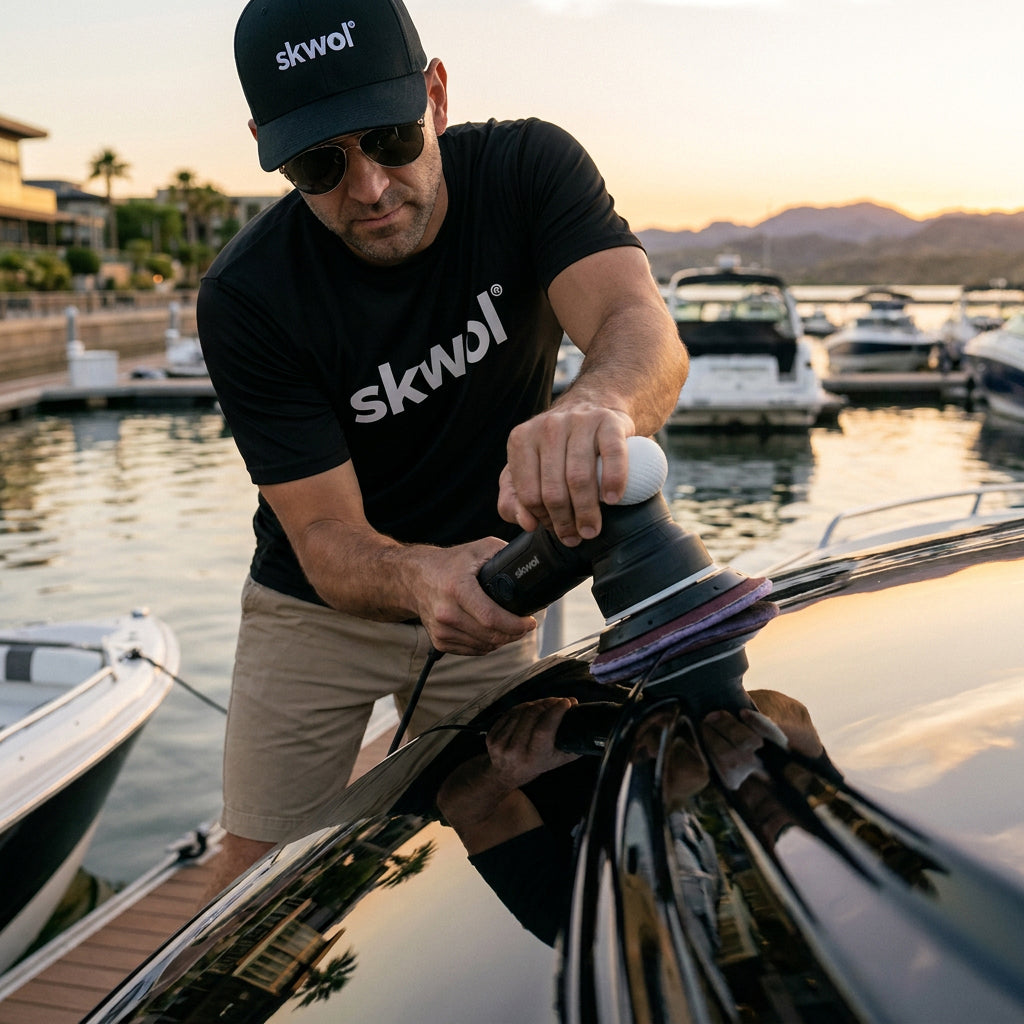
A chalky hull needs a careful diagnosis before it needs a stronger compound. Start by identifying the finish, washing it thoroughly, and testing the least aggressive correction method that restores an acceptable finish. If the test area stays dull or shows damage, stop and reassess before removing more material.
This guide covers smooth, glossy gelcoat above the waterline. Painted hulls, non-skid decks, vinyl wraps, and clear plastics need their own care instructions. A product that works well on one of those surfaces may damage another.
Understand what you are correcting
Gelcoat is the resin-rich outer finish on many fiberglass boats. Sunlight and weathering can reduce its gloss and leave it looking faded or chalky. Interlux identifies UV exposure as a cause of gelcoat fading. Compounds use abrasives to remove affected surface material and refine the finish; a wash removes loose contamination. Those jobs require different products.
A wet hull can look much better than the same hull after it dries. Make your decisions on a clean, dry surface in consistent light. A brief improvement in appearance does not tell you how much sound gelcoat remains or whether a previous owner has already compounded it repeatedly.
Before starting, check the boat's records for repainting or repairs. If you cannot identify the finish, ask the builder, paint supplier, or a qualified detailer. Awlgrip specifically prohibits polishing compounds on its G/H Line topcoat. Do not apply generic gelcoat correction instructions to that paint.
Wash and separate contamination from finish damage
Rinse away loose grit and salt, then wash with a cleaner approved for the surface. SKWOL's pH Neutral Foaming Boat Soap is the wash option in our maintenance range. Use the current label's dilution and rinse instructions. Work on cool surfaces and keep dirty wash tools away from the clean finish.
After drying, inspect several areas rather than judging the entire hull from one patch. Look for differences between exposed and sheltered sections, repair boundaries, water-spot outlines, scratches, and cracks. If washing removes the haze, you may be dealing mainly with contamination. If dullness remains, a correction test can help establish the next step.
Stop for blistering, peeling, exposed laminate, or cracks that need assessment. Compounding cannot fill missing material or repair a failing finish. The same caution applies when you see an unknown coating lifting or changing color during cleaning.
Make a small test area your decision point
Choose a representative, inconspicuous area with room to work safely. Photograph it dry before starting. Use a gelcoat-compatible product and the pad and machine combination recommended for that product. Grady-White advises starting with the least abrasive method that achieves the result.
For an appropriate gelcoat correction job, SKWOL One-Step Oxidation Remover is our compound option. Its current instructions describe a small working section, light pressure, overlapping passes, and microfiber residue removal. Follow the current label rather than borrowing machine speeds or sanding grades from another manufacturer's system.
After working the test area, remove residue using the product's approved cleanup method. Inspect the dry finish from more than one angle. Ask three practical questions:
• Has the chalky appearance improved enough for the result you want?
• Is the gloss reasonably even, or are haze and machine marks still visible?
• Is the surface sound, with no new damage or unexpected change in the finish?
Record the product, pad, and technique that worked. A successful test gives you a repeatable process. A poor test gives you a reason to change the plan before treating the whole boat.
Keep correction controlled across the hull
Work in manageable sections and inspect as you go. Protect adjacent trim and fittings from compound and pad contact. Keep pads clean and replace overloaded or damaged pads according to their instructions. Use separate clean towels for compound removal and final protection.
Do not compensate for slow progress by dwelling in one spot, leaning harder on the machine, or making repeated aggressive passes without checking the result. Grady-White warns that heat from a stationary buffer can damage the surface, and its owner's guidance cautions that excessive compounding wears away gelcoat.
Edges, corners, and previously repaired sections deserve extra caution. If you cannot work safely around them, leave those areas for a professional. Follow the tool's electrical safety guidance and the product safety data sheet for protective equipment.
Know when sanding needs a professional assessment
Some heavily weathered gelcoat needs more than a polishing step. 3M's heavy-oxidation procedure includes optional sanding before buffing, depending on the condition of the gelcoat. Sanding is therefore a valid repair method in the right circumstances, rather than a routine first step for every faded boat.
The difficult part is deciding whether your particular finish can tolerate it. Ask a qualified marine finisher to evaluate remaining material, repair history, defect depth, and the likely result. A professional should also explain how sanding marks will be removed and where the restoration will stop.
Do not select a coarse grit simply because another boat looked good in a video. If the finish is too thin or deteriorated to correct safely, repair or refinishing may be the better outcome. More abrasion cannot rebuild the material it removes.
Protect the corrected finish and maintain it
Once the surface meets your expectations, complete the protection product's preparation steps. Some systems require a dedicated preparation cleaner. Use one only when approved for the finish and the protection you plan to apply.
SKWOL AF-S Marine Sealant is the current sealant in our protection range. Check its current application guidance and your finish manufacturer's compatibility requirements. Keep gloss-enhancing products off walking areas unless explicitly approved for that use.
Continue washing, rinsing, and drying the boat regularly. Inspect the finish after cleaning rather than treating every loss of beading or shine as a reason to compound again. Reserve abrasive correction for an identified defect.
Common gelcoat oxidation questions:
Will wax remove oxidation?
A protective wax without abrasives will not perform the same correction as a compound. Products sold as cleaner waxes can combine cleaning or abrasive action with protection, so read the product description and directions. 3M's gelcoat range includes both dedicated compounds and compound-plus-wax products.
Can every oxidized boat be restored in one step?
No single process can guarantee the same result on every finish. Use the dry test area to decide whether the result is acceptable. A second finishing stage, specialist assessment, or repair may be needed.
What should I send when asking for help?
Send clear dry-surface photos, the boat's age, the known finish, and any correction or repainting history to SKWOL support. Those details make product guidance more useful than a photo of a wet, freshly wiped hull.
Share:
10 Worst Foods and Snacks to Bring on a Boat: What Can Stain or Damage Boat Seats?
How to Remove Boat Water Spots Safely by Surface