

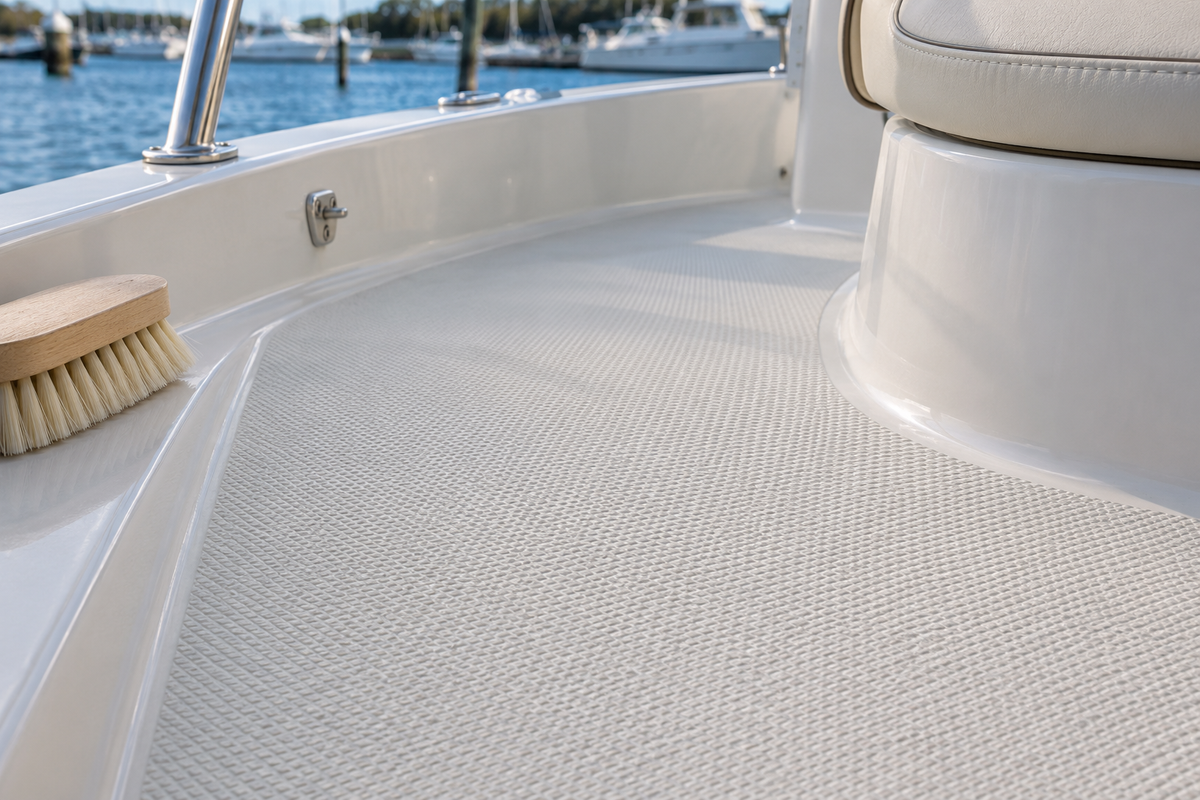
Molded non-skid walking areas can have different care instructions from adjacent smooth gelcoat. AI-generated illustration.
Do not automatically carry the hull's waxing or polishing routine onto a molded non-skid deck. Check the boat's care instructions first: some manufacturers prohibit wax on non-skid, while others call for a treatment made specifically for those surfaces.
The useful question is whether the exact treatment is permitted on that walking area.
Separate smooth gelcoat from the walking deck
A glossy cabin side and a textured cockpit floor may both have a gelcoat finish, but their maintenance instructions can differ.
Boat manuals may recommend wax or polish on smooth gelcoat while expressly excluding non-skid areas because wax could make them slippery. A product being suitable for fiberglass does not, by itself, establish that it belongs on every fiberglass surface aboard.
This guide is about molded gelcoat non-skid. Applied deck coatings, teak and foam flooring have their own instructions. For foam pads, see our EVA foam decking guide.
Start with an ordinary cleaning pass
Remove loose dirt, then use the mild wash and brush recommended by the boat manufacturer. Work the cleaner into the texture without turning a routine wash into an abrasive restoration job. Rinse thoroughly to remove the cleaner and loosened dirt.
If the soap already in your wash kit meets those instructions, the textured deck does not automatically require another bottle. Follow the product's dilution and rinsing directions.
Build this into your regular after-use boat wash, keeping the appropriate tools for each surface.
Check any finish treatment separately
Some manufacturers recommend non-skid-specific treatments. That does not make ordinary hull wax, a gloss dressing or a ceramic sealant interchangeable with them.
Before applying a finish product, check two things:
- Does the boat manufacturer permit that type of treatment on this non-skid surface?
- Do the exact product's instructions explicitly cover the textured walking area and give the required application and drying procedure?
If the boat manual says not to wax the non-skid, follow that instruction. Do not assume a product's general fiberglass claim overrides it.
The words “wax,” “polymer” or “ceramic” alone are not enough to decide suitability.
What if the deck still looks dull?
Inspect it after cleaning and drying. A remaining stain, chalky finish or worn area needs the appropriate surface-specific treatment, not an automatic pass with a buffer.
Keep a smooth-hull correction process separate unless the boat manufacturer provides a restoration method for the non-skid. There is no need to chase the reflection of the adjacent glossy panel.
For routine care, focus on clean texture and the maintenance your boat's instructions actually call for.
Share:
How to Clean Stainless Steel Boat Rails